
Quick and Creamy Farmer’s Cheese
[Liz] A few years back, Jeffrey taught me the simple cheese-making process he had learned years ago from a friend who was a goat herder. Not for the first time, Jeffrey filled the role of the Jewish grandmother I never quite had. He was more familiar with DIY kitchen tips than I was, and he loved watching over my shoulder as I tried them myself. Together, we stood over a large pot of milk, and the cheese we strained that day was fresher and creamier than I knew farmer’s cheese could be.
Farmer’s cheese (and its less-crumbly cousin, pot cheese) tends to be fairly bland on its own. Higher-quality milk makes for richer flavor, but we also like to add salt and fresh herbs. For something really deluxe, place your farmer’s cheese in olive oil and herbs and let it sit in the refrigerator for a couple of days before serving with bread or crackers. We use homemade farmer’s cheese for our Sweet Blintzes (see page 224), Pierogi (page 140), and Cheesecake with Currant Glaze and Caraway Crust (page 271). This recipe calls for a cooking thermometer, which isn’t necessary, but is helpful to know exactly when to remove your milk from the heat and to ensure the maximum yield. Note that the yield may vary slightly.
Serving Size
Makes 1½ pounds farmer’s cheese (about 3 cups)
Ingredients
1 gallon whole milk
½ cup distilled white vinegar
2 tablespoons minced garlic (optional)
2 heaping teaspoons finely minced fresh herbs, such as chives, parsley, and sage (optional)
1 teaspoon kosher salt (optional)
Instructions
In a heavy-bottomed medium pot or saucepan, heat the milk over medium-low heat, stirring frequently to avoid burning, for 15 to 20 minutes, or until the milk reaches 180° to 190°F. The time will vary depending on the size of your pot and your stovetop. Look for a bubbly white foam to form all over the surface of the milk, but do not let the milk boil. Remove from the heat.
Immediately pour in the vinegar and stir gently. The milk will instantly begin to curdle. Milk solids will form and separate from the yellowish whey. Let sit for 15 minutes.
While the cheese curdles, drape a large piece of cheesecloth over a colander or large, fine-mesh strainer set over a large bowl. Gently pour or ladle the milk solids and the yellowish whey into the cheesecloth. Either discard the whey that collects in the bowl or set it aside for another use. Run the cheese curds under cold water for about 5 seconds. Let drain in the sink in the colander for a few minutes.
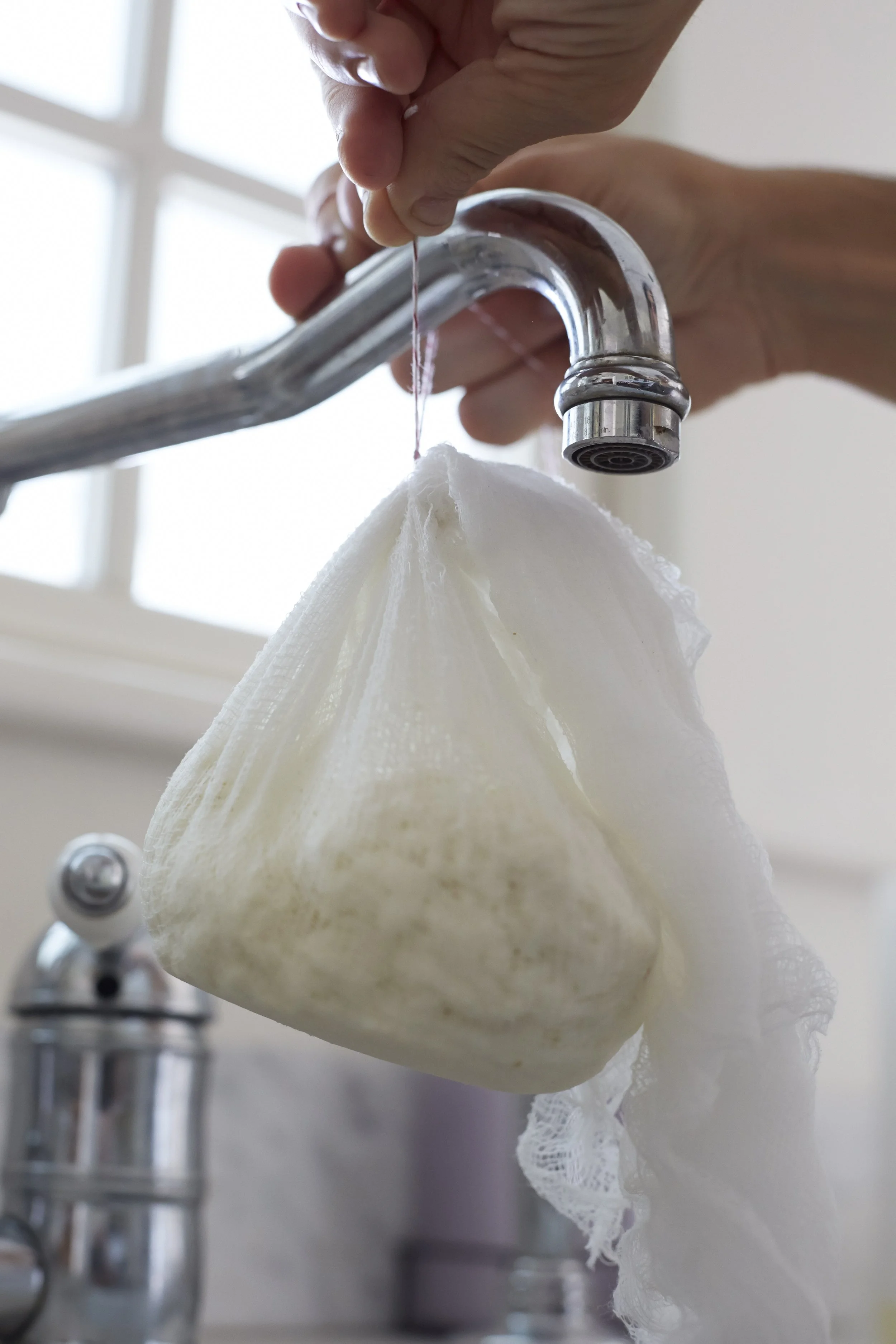
Tie the corners of the cheesecloth into a knot. Hang the bundle from the knot on a hook, ideally over the sink or a bowl, and let the cheese drip for about an hour to remove excess whey. You may have to improvise to find a way to hang your cheesecloth if you don’t have a hook handy. Hooks on wire hangers work well.
After about an hour, open your cheesecloth bundle. If desired, transfer the cheese to a bowl and stir in the garlic, herbs, and salt, or just leave the cheese plain. Pack the cheese into an airtight container and refrigerate or use immediately in another recipe. Farmer’s cheese will keep in the refrigerator for 5 to 7 days. It also freezes well—just defrost it in the fridge for 4 hours before using as filling for Sweet Blintzes.
Excerpted from the book THE GEFILTE MANIFESTO by Jeffrey Yoskowitz & Liz Alpern. Copyright © 2016 by Gefilte Manifesto LLC. Reprinted with permission from Flatiron Books. All rights reserved. Photography by Lauren Volo.